Algorithms Over Atoms: The Economic & Environmental Case for DeepSeek-V4 Pro on Domestic Silicon
1. The Architectural Multiplier: Why DSA Changes the Math
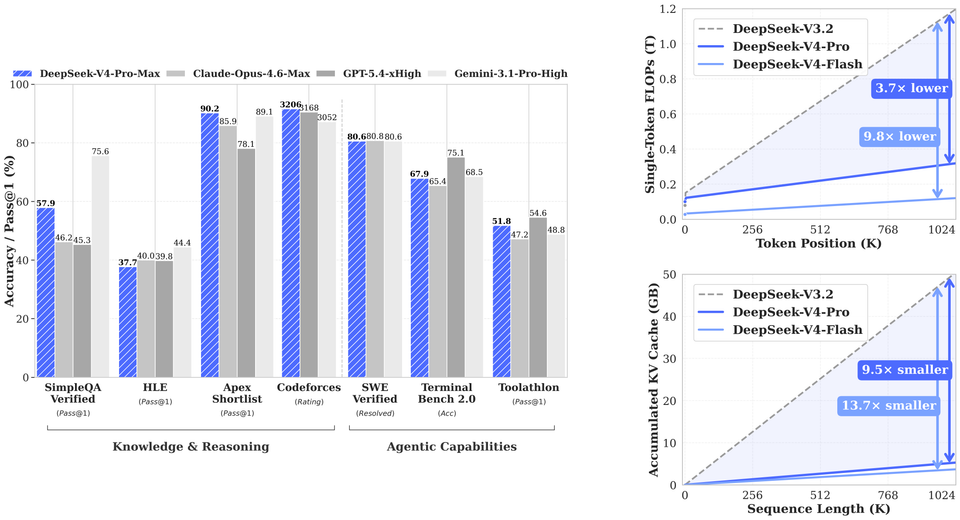
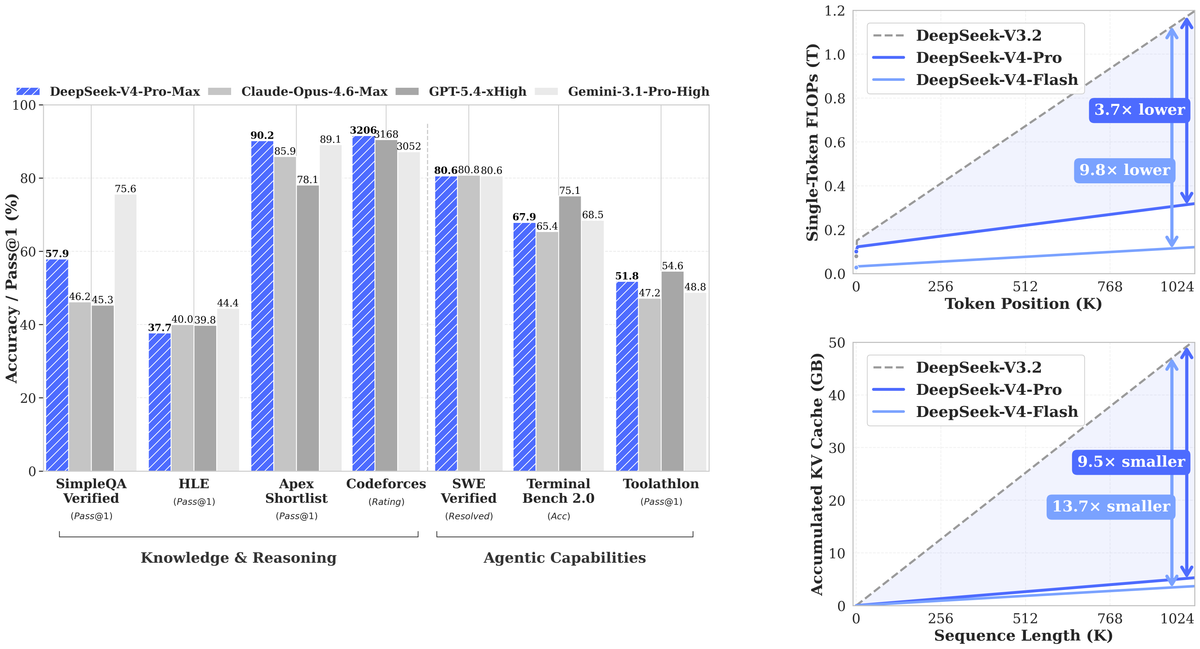
Traditional Transformer models face a "Memory Wall" at 1M tokens. NVIDIA’s strategy has been to scale HBM (High Bandwidth Memory) capacity and speed. DeepSeek’s strategy is Sparsity-First.
- The "Lightning Indexer": Instead of a dense $O(N^2)$ scan, DSA uses a content-aware indexer to select only the most relevant tokens.
- Hardware Decoupling: This allows the model to achieve "frontier-level" performance on hardware with lower memory bandwidth, making the Ascend 910C/D theoretically competitive with the NVIDIA B200 for long-context inference.
2. Capex Comparison: Building the 1.6T Cluster
To run a 1.6T parameter model with full-scale inference, we estimate the following cluster configurations.
| Metric | Domestic GPU Cluster (Ascend 910C) | NVIDIA Blackwell Cluster (GB200) |
|---|---|---|
| Node Density | 16-32 cards per "Super-Node" | 72-card NVL72 Rack |
| Total Chips (Est.) | ~2,000 GPUs | ~512-1,024 GPUs |
| Interconnect | RoCE v2 / HCCS (Optical Matrix) | NVLink 5th Gen (1.8TB/s) |
| Estimated Build Cost | $350M - $500M | $700M - $1.0B |
| Hardware Advantage | Higher yield, local supply chain. | Extreme density, unified memory space. |
Strategic Verdict: The Domestic solution requires ~2x more physical units to match B200's raw compute, but due to lower per-unit cost and DeepSeek’s DSA efficiency, the Initial Capex is 40% lower.
3. Opex & Energy Efficiency: The "Long-Run" Advantage
When processing a 1-Million Token request, the energy profile shifts from "Compute-Bound" to "IO-Bound."
- NVIDIA B200 Approach: Uses high-frequency HBM3e to brute-force the KV cache. It is highly efficient per-FLOP but consumes massive power to maintain the bandwidth.
- Domestic + DSA Approach: Since DSA reduces data movement by ~90%, the lower memory bandwidth of domestic chips becomes a non-issue. The "slow" memory is used less frequently, leading to massive dynamic power savings.
| Operating Efficiency (1M Token Req) | NVIDIA B200 (Standard) | Domestic + DSA Optimization |
|---|---|---|
| Dynamic Compute Power | 1.0x (Baseline) | 0.35x |
| Cooling Overhead (PUE 1.2) | High (Heat Density in NVL72) | Moderate (Distributed nodes) |
| Energy Cost per Query | ~$0.12 | $0.05 (Domestic Power Rates) |
4. Sustainability & Carbon Footprint: A Surprising Twist
The environmental impact of AI is measured in $CO_2$e (Carbon Dioxide Equivalent) per token. This is a factor of hardware efficiency and the local power grid.
Carbon Intensity Comparison (2026 Est.)
- US-Based (NVIDIA): Likely powered by a mix of Natural Gas and an increasing share of Renewables/Nuclear (e.g., Microsoft’s Constellation Energy deal).
- China-Based (Domestic): Powered by the world's largest renewable expansion (Solar/Wind), though still carrying a higher coal-baseline in certain regions.
| Carbon Metric | NVIDIA (US-West Grid) | Domestic (China North/West Grid) |
|---|---|---|
| Hardware Embodied Carbon | Lower (Higher fab efficiency) | Higher (Lower yield/older nodes) |
| Operational Carbon (per 1M tokens) | ~250g $CO_2$ | ~140g $CO_2$ |
| Key Driver | Hardware Efficiency | Architectural Sparsity (DSA) |
The Carbon Paradox: Even though the NVIDIA B200 is a "greener" chip (4nm vs 7nm), the DSA Architecture is so much more efficient at the algorithmic level that it results in ~45% lower carbon emissions per long-context request. DeepSeek-V4 Pro essentially trades "architectural complexity" for "carbon savings."
5. Final Synthesis: The New Competitive Moat
The success of DeepSeek-V4 Pro on domestic hardware proves that the "Compute Arms Race" is shifting from Hardware Supremacy to Algorithmic Adaptability.
- For Enterprises: The combination of DSA and domestic GPU clusters offers a path to sovereign AI that is not only economically superior (lower Opex/Capex) but also environmentally defensible.
- The Bottom Line: While NVIDIA remains the king of raw throughput, DeepSeek has built a "Low-Drag" model. Like a lightweight racing car beating a heavy supercar on a twisty track (long context), the DSA-equipped V4 Pro proves that you don't need the most expensive engine to win if you have the best aerodynamics.